Science
MIT fine-tunes nanoparticles for cancer vaccines
By altering the surface of virus-based nanoparticles, MIT researchers have developed vaccine formulations that offered better protection in mouse experiments. The goal is personalised cancer vaccines, but the mice in these experiments were vaccinated before they received tumour cells.
3 min read
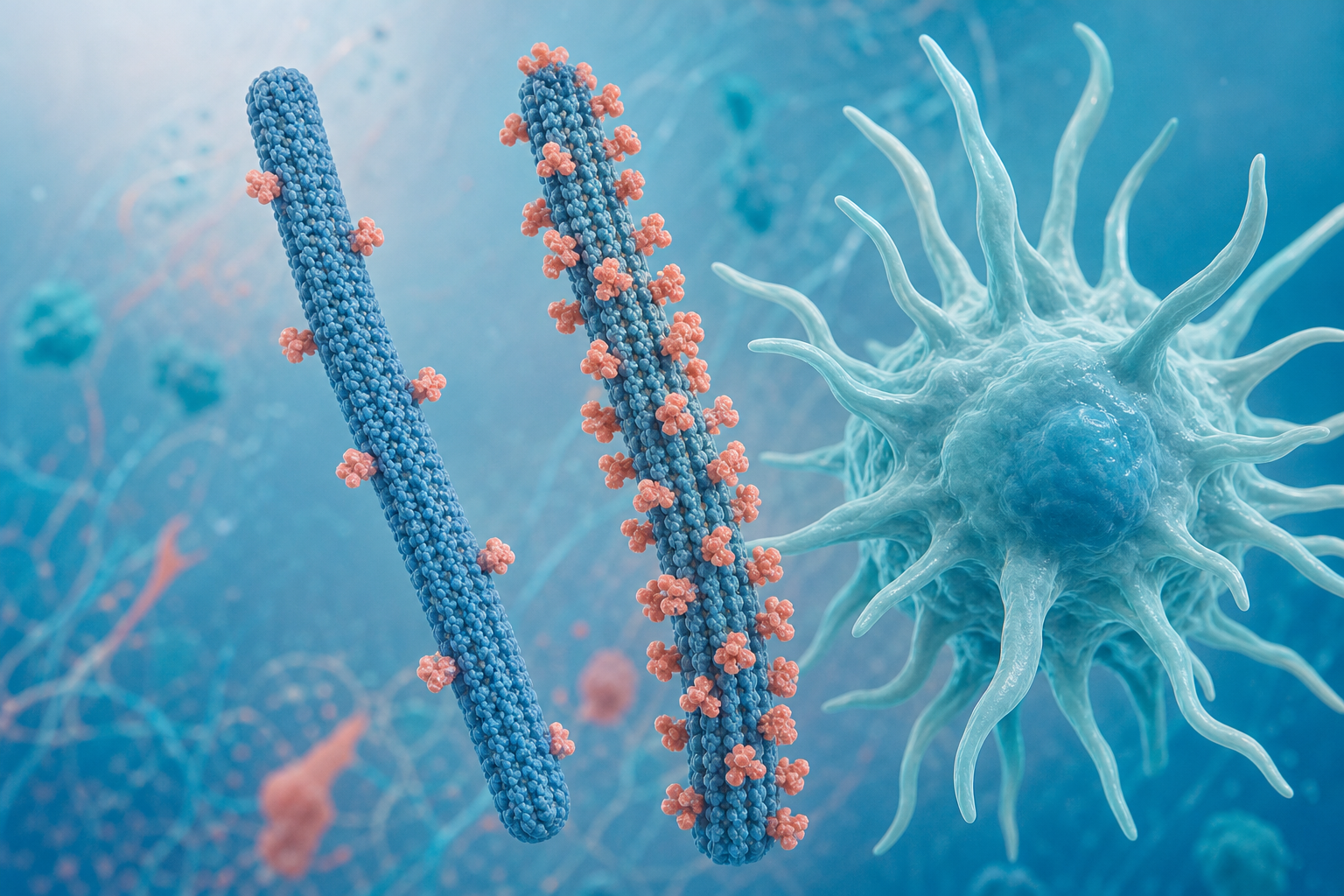
MIT researchers have developed a way to control how densely antigens are arranged on a virus-based nanoparticle. Antigens are molecular features that the immune system can learn to recognise. The idea is for the particle to display targets from tumour cells, helping the immune system direct a response against those cells. The scaffold is the M13 bacteriophage, whose protein coat forms a long, thin thread. [1]
Through genetic changes, the researchers could alter the proportion of surface proteins carrying an antigen. Using the model antigen SIINFEKL, MIT says they could produce particles with densities ranging from about 6 to 70 per cent. But the central animal experiments did not test that full range: they compared formulations with roughly 6 and 35 per cent. The latter offered better protection. [1]
The order of the experiments matters when interpreting the result. The mice were vaccinated first and then given injections of tumour cells. This tests whether a primed immune system can resist a later tumour-cell injection – not whether the vaccine prevents spontaneously developing cancer or treats an existing tumour. [1][2]
One experiment used melanoma cells engineered to carry SIINFEKL. According to MIT, mice given the formulation with more antigen developed tumours less often and produced more T cells targeting the same antigen. The researchers also found that dendritic cells, which help activate T cells, took up the higher-density particles more readily. This offers a possible partial explanation for the difference in immune response. [1]
The team then switched to ADPGK, a tumour-specific target in a mouse model using colon cancer cells. Again, the formulation with more antigen worked better. According to The Brighter Side of News, which describes the same study, tumours grew more slowly after the cancer cells had been injected under the skin. This was therefore a model using colon cancer cells, not an experiment in which mice spontaneously developed cancer in the bowel. [1][2]
One crucial methodological question remains, however: a denser arrangement also meant more antigen overall. The Brighter Side of News reports that the mice received equal numbers of particles, but that the antigen dose in the melanoma experiment was 1.5 micrograms with the lower-density formulation and 8.5 micrograms with the higher-density one. The comparison therefore shows that the denser formulations carrying more antigen worked better under the experimental conditions. It does not establish how much of the improvement came from the spacing between antigens itself and how much came from the larger dose. [2]
Nor is the highest possible density necessarily the best choice. According to the same report, the highest density yielded substantially fewer particles during production. A genetic change that reduced the density to around 35 per cent improved the yield. Further development therefore needs to balance the immune response against how readily the particles can be manufactured. [2]
The link to personalised cancer vaccines is that the antigens can be replaced while retaining the underlying platform. The researchers envisage adapting it to targets in an individual patient's tumour. No such treatment for humans was created in these experiments. [1][2]
For that goal, the next important test is whether this particular new design can improve the attack on established tumours, and whether more tumour antigens work equally well on the platform. Better protection before an injection of tumour cells does not answer those questions. [1][2]