Science
Magnetic beads track muscles in bid for better prosthesis control
Small magnetic beads in muscles provided promising control signals in a screen-based test involving people with below-knee amputations, MIT reports. The trial does not, however, show that the technology improves walking with a physical prosthesis.
2 min read
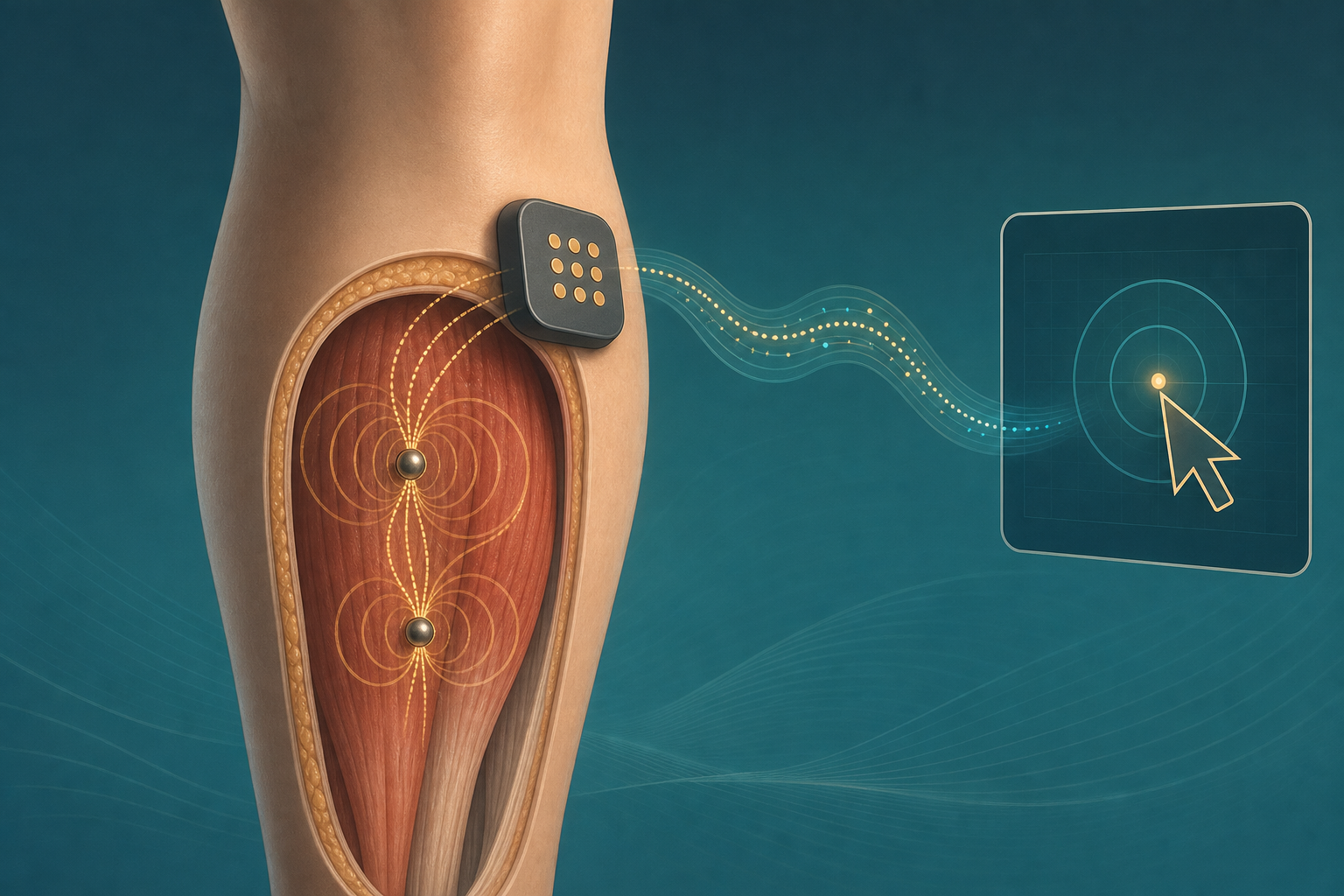
The technique, called magnetomicrometry, measures how a muscle moves rather than its electrical activation. Small magnetic beads are placed in muscle tissue and tracked by sensors on the skin. As the distance between two beads changes, the system can calculate how the muscle shortens or lengthens and how quickly that change occurs. The beads are three millimetres in diameter; according to MIT, the customised sensor system can detect them at depths of up to six centimetres. [1]
This provides a different kind of information from electromyography, or EMG, in which electrodes record a muscle’s electrical activity. That activity then has to be translated into estimates of movement to control a prosthesis. According to MIT, the electrical signal does not always reflect the muscle’s mechanical state. Skin electrodes can also pick up activity from other muscles and be affected by sweat. The potential advantage of magnetic measurement is therefore a more direct signal of the movement itself. [1]
The study involves three people with below-knee amputations and, according to MIT, is being published in the journal Nature Sensors. The participants had both magnetic beads and electrodes implanted in their muscles. This allowed the researchers to compare magnetic measurement with EMG from both implanted electrodes and electrodes on the skin. The participants did not wear a prosthesis during the tests. Instead, their tasks included using muscle movements to steer a cursor towards targets on a screen. According to the researchers, the comparison suggests that magnetic measurement could provide more precise and stable control. [1]
But holding a cursor still and moving it to a target are different skills. The research group’s November 2025 preprint, which had not been peer-reviewed, already reported tests in humans. In that version’s cursor test, involving two participants, magnetic measurement produced a steadier cursor and more time within the target area. Implanted electrodes, however, produced straighter movements towards the target. Those results therefore do not suggest that magnets performed best on every measure. [5]
Who the technology could help is also an open question. All three participants had undergone a special surgical reconstruction called AMI. This reconnects muscles with opposing functions so that they can continue to work together in the remaining part of the leg. It helps provide feedback about movement and position. The trial therefore does not establish how well the same measurement method works in people with a conventional below-knee amputation without this reconstruction. [1]
MIT says the researchers are now conducting a larger study using magnetic measurement to evaluate prosthesis control. [1] For users, the next crucial question is whether the promising signal also provides better control when a physical prosthesis has to support the body and function during walking.
Sources
- Magnetic sensors track muscle movement, for better prosthetic limb control | MIT News | Massachusetts Institute of Technology ↗MIT News
- Magnets could offer better control of prosthetic limbs | MIT News | Massachusetts Institute of Technology ↗MIT News
- Magnetic sensors track muscle length | MIT News | Massachusetts Institute of Technology ↗MIT News
- Publications | High-Performance Human Interfacing Lab ↗HiPhi Lab
- A wireless magnetic implant system for continuous neuromuscular sensing ↗medRxiv