Automotive
Tesla’s Roadster takes to the air – but the stunt is no proof of a finished flying car
Tesla’s new Roadster has reportedly performed spectacular airborne manoeuvres using compressed air. But the stunt car, the car on stage and the planned customer versions must be kept distinct – and the demonstration establishes neither sustained flight nor an approved product.
6 min read
A car leaving the ground is a powerful sight. But the sight alone does not tell us how long the car can stay there, how well it can be controlled or what happens when something goes wrong. That is where Tesla’s new Roadster stands: between a spectacular prototype demonstration and the promise of a car customers will be able to own.
At the presentation at SpaceX’s Texas facility on 15 October 2026, a Roadster prototype was described as driving upside down on a curved ramp, becoming airborne, rotating and landing. Car and Driver and CBS/AFP both report on the demonstration. That is not the same as an independent test demonstrating sustained flight. [1][2]
The accounts also need to be kept distinct. Car and Driver’s first article describes the prototype leaving the ramp and performing a roll in the air. CBS describes a 180-degree rotation before it landed on its wheels. Car and Driver’s technical follow-up includes another manoeuvre: a jump without a ramp over five Tesla vehicles, including a Semi lorry. These accounts cannot be pieced together into a single established sequence of events. [1][2][3]
The presentation is described as having been broadcast live. That does not establish that every stunt sequence took place at the moment viewers saw it. This needs to be checked against the original material.
For anyone considering what Tesla has actually built, a more important distinction is already explicitly documented: the stunt prototype was not the same car that was driven onto the stage. Car and Driver points to different wheels, among other things. Exactly what technical differences there were between the cars is not clear. [1]
Air for lift – and air for grip
Behind the demonstration are two systems with almost opposite jobs. One is intended to lift the car off the ground. The other is meant to help it stay in contact with the surface, even when that surface is above the car.
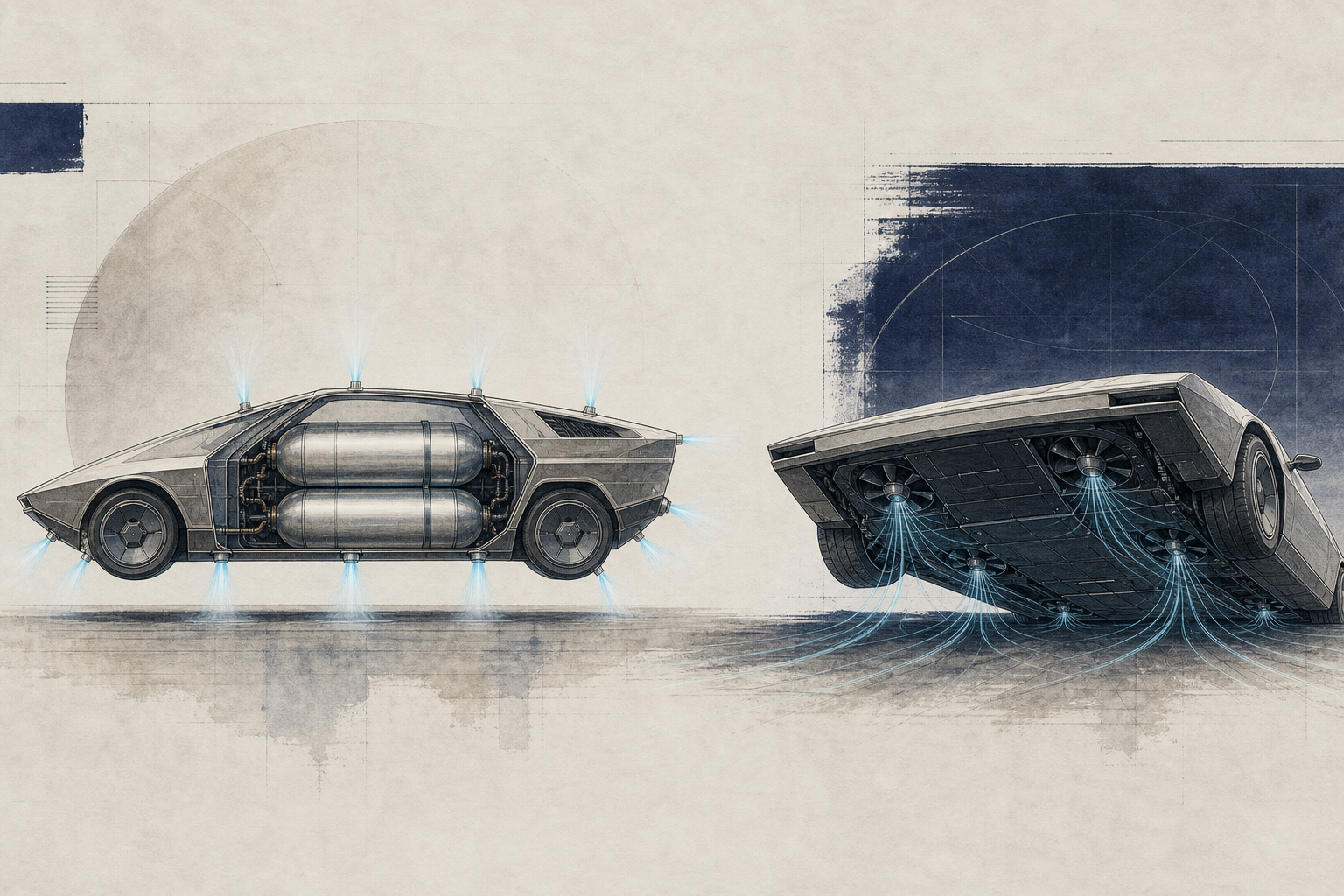
According to Tesla, the lift comes from what are known as cold-gas thrusters from SpaceX. This does not involve burning rocket fuel: highly compressed air is released through nozzles to generate force in the opposite direction. Tesla describes ten thrusters around the car, intended to provide forward and upward movement as well as rotation. Electric actuators are intended to allow small, precise adjustments. That is the company’s description of the control system, not independent verification of its precision. [1][3]
Car and Driver’s follow-up reports that the car which made the jump without a ramp had two pressure vessels holding a total of 250 kilos of air. The vessels took the place of the passenger seat. It is a concrete reminder that the technology takes up space, and that this particular stunt car was not an ordinary two-seater sports car with an extra driving mode. [3]
The fan system works in the opposite direction. According to the description, fans draw air out from beneath the car, while a system that seals against the surface helps create suction. Tesla claims the force is enough to hold the car against an overhead, upside-down roadway even when stationary. On a normal road, the same principle is intended to give the tyres more grip. [1][3]
Tesla’s head of vehicle engineering, Lars Moravy, describes two modes: suction at low speeds and a higher-speed mode in which sections at the front and rear open to increase airflow beneath the car. A movable rear wing is also intended to help press the car onto the road. These are separate solutions for grip and airborne movement, not a single system that does everything. [1][3]
Musk says the car will be able to refill its own air tanks. But the reporting provides no verified answers on how long refilling takes, how many manoeuvres can be performed in succession or how the systems cope with a fault. For usability, those questions matter at least as much as whether the car can take off once. [1][3]
The acceleration figures deserve the same scrutiny. At the presentation, the time to reach 60 mph, or just under 97 km/h, was first given as one second and then as 0.8 seconds. Car and Driver describes the times as claimed results. No independent timing or adequate description of the measurement conditions is provided. Nor is this a measured result for 0–100 km/h. [1]
Three versions – but promises yet to be fulfilled
Tesla describes three planned versions. Performance is intended to be a two-seater with a fan system and an active rear wing. Thrust is intended to add rear-facing cold-gas thrusters. Rocket is planned as a single-seater, with additional thrusters around the car for lift and rotation. These are product plans, not proof that the stunt prototype’s capabilities will be available in a car delivered to customers. [1]
The distinction also matters when ordering. According to CBS, a non-flying Roadster can be reserved with a deposit of 5,000 dollars. Thrust is described as a limited version that cannot yet be reserved, while Rocket, with its full flight system, is to be offered by invitation only. A Roadster reservation is therefore not the same as an order for the car that performs airborne tricks. [2]
Musk gives 2028 as the target for the start of production. No final price was announced. Car and Driver’s technical follow-up also stresses that the publication is not saying all the technology shown will reach production. Its two articles are reporting from the same publisher, not two independent technical verifications. [1][2][3]
A regulator’s statement is not a green light
According to both CBS and Car and Driver, Tesla says Rocket is not approved for use on public roads. That is a substantial restriction, not a footnote to the performance promises. [2][3]
CBS also relays a statement from the US Federal Aviation Administration, the FAA: the vehicle does not meet the agency’s definition of an aircraft. But that does not mean the FAA has approved it as a flying car. CBS describes regulatory responsibility as unclear and reports that the road safety agency NHTSA had not answered the publication’s questions. The available information does not establish which configuration the FAA assessed or the full basis for its assessment. [2]
So it is not just a price tag that is missing. The reports provide no independently measured flight time, airborne range or endurance. Nor do they show what safety margins exist in the event of a loss of pressure or a failed landing. That does not prove longer flight is impossible. It means it has not been established here.
The Roadster demonstration offers a fascinating view of what compressed air, fans and control systems can be used for. But between putting a prototype through a spectacular stunt and selling a safe, legally permitted flying car that can be used repeatedly lie precisely the questions the demonstration leaves unanswered.
Sources
- Revealed! New Tesla Roadster Takes Flight with SpaceX Thrusters ↗Car and Driver (reveal)
- With Tesla Roadster debut, Elon Musk shows "flying cars are real" - CBS News ↗CBS / AFP
- Explained: Here’s How the Tesla Roadster Flies, Flips, and Sucks ↗Car and Driver (technical follow-up, Oct 17)